Saturday, April 21, 2018

ARTFUL READERS CLUB
THE TUSCAN CHILD by Rhys Bowen 


THE TUSCAN CHILD, by Rhys Bowen, is a blend of romance, mystery and engaging fiction. The tale is told through a dual timeline...half the story takes place during WWII: Hugo Langley, an English pilot, crashes in the Nazi-held hills of a fictional town in Tuscany, Italy. (How does he remain hidden and how does he survive?) The other half is about Hugo's estranged daughter, Joanna, who, thirty years later, finds some puzzling papers among her father's belongings following his recent death in England. These papers are so compelling that she's driven to journey to Tuscany to solve the enigma. We travel with Joanna from Surrey, England, in the early 1970s into the lush, rolling hills of Tuscany and the small village of San Salvatore, as she searches for clues to her father's past.
A mix of historical fiction, romance, mystery and murder, the book is well written and absorbing as were the colorful characters. THE TUSCAN CHILD was a good marriage of past and present...it's a heartwarming story filled with descriptions of delicious Italian foods and pleasant, welcoming villagers.
Definitely worth a read...

Thanks for checking in...
Big Hugs,
abbyj

Sunday, April 8, 2018


ARTFUL READERS CLUB
A COLUMN of FIRE by Ken Follett 
APRIL 9, 2018


"The simple idea that people should be allowed to worship as they wished caused more suffering than the ten plagues of Egypt."     (Ned Willard, fictional spy for Queen Elizabeth) 

If you want to be hypnotized and completely engrossed  in page-turning, compelling historical fiction, Ken Follett is THE author...A COLUMN of FIRE is THE book!  The final book in the Kingsbridge trilogy (following "Pillars of the Earth" and "World Without End,") this 750+ page tome spans the years 1558 to 1620...some of the most turbulent and violent times in world history. It takes a look at the beginning of religious freedom in Western Europe. Religion, politics, war and European history come together in England, France, Spain and the Netherlands. We sense how our Kingsbridge community (and those beyond) feel about what they must do to live the kind of lives they wish to live.  It's all about power, spying, violence and intolerance. (Sounds like today!!)  The novel was hardly about the make-believe town of Kingsbridge and didn't dwell on its residents, differing from the other two trilogy volumes. Rather, it was about the developing world  and the wider struggles between Catholics and Protestants. Perhaps this was because by this time, sea travel and exploration was becoming more common.
For the fans of the Kingsbridge series, A COLUMN of FIRE comes back to the town with the big Cathedral and some familial descendants of the colorful characters living in the first two trilogy books. In this volume, we experience the tumultuous reign of Queen Elizabeth and the battle of the Catholic and Protestant religions for the souls of the citizens of the West.
We meet a large cast of villains and heroes, both real and imagined, who want to impose their beliefs on all...tolerance was not an option!  Follett weaves the happenings of the times into the story line and puts the reader in the middle of the action. It was a stormy time and the fact that it was caused by religious choice seems unimaginable to me. What was done in the name of religion... Yet, the intolerance we often see today by religious fanatics who, just like in Elizabethan times, murder and plunder in the name of God, makes me wonder...will we ever learn? Will this religious conflict (if it is purely religious,) ever end? Just as it was a difficult and dangerous time to live in 16th century Western Europe, it's almost as frightening and sad living in today's world!

A COLUMN of Fire by Ken Follett...it definitely lit a flame in my literary heart. I highly recommend it!!

Thanks for stopping by,
abbyj 

Wednesday, April 4, 2018

On the Road to Marrakech
Morocco, Part Two
March 30, 2018

OK...I admit it! I was blown away by the variety and beauty of Moroccan art on every step of our journey. There was some form of artistic expression wherever I looked...even on the oh, so ancient, crumbling tiled fountains, walls, doors and the cobbled and tiled streets. The paintings and drawings were equally amazing.


 L


Driving through the scenic cedar forests of the Middle Atlas Mountains (towards the Sahara Desert,)  the images I held when visualizing  Morocco were considerably altered. I thought of Morocco as a  place with narrow, maze-like streets lined with ancient, earth-colored buildings...it's still all of that. But, added to this vision is a remarkable place named IFRANE. It's a town that's unlike any other in Morocco. Located 5,460 feet above sea level in the Middle Atlas Mountain region, this small hill town is the Kingdom's Switzerland. Very European in feeling, it's a sharp contrast to the hot, dry climate that surrounds it....and it has snow!!! It's an  alpine-like village that's a winter playground for the affluent from the Kingdom's big cities. Boasting about 5000 residents, the King has one of his palaces here. It's the only place we saw snow and homes not at all like those in other cities or towns.
We explored a bit, then continued on to our desert destination. At some point, we left our regular vehicle and switched to a 4X4 to navigate the  sandy terrain and dunes of Erg Chebbi. A sunrise-camel-ride was on our schedule...something that excited all of us. Everyone went but me...I was sick!! (Michael and our guide took these photos.) We were  isolated at our desert encampment...it was lovely!


I must say, somewhere in this posting, that the Kingdom of Morocco has the bluest skies... consistently... that I've seen in a long time. Coming from a place where the sky is normally shades of gray, it was an awe-inspiring change! 

The road we were on was exceptionally twisty... made me nauseous! But, somewhere along the way, my "sick bug" seemed to migrate to our friend's system. Not fun...but our next stop was fun and AMAZING! We stopped along the road for a look  at  The ATLAS CORPORATION STUDIO...Morocco's Hollywood. We could tell it was going to be special because it had a Hollywood feel before we even entered the main gates! It was extraordinary to see all the very famous movies that have been filmed there...in part or completely: Ben Hur, The Ten Commandments, Hercules, Red Tent, Spy Game, Cleopatra, Babel and Game of Thrones...among many others. We visited several of the sets and were in awe of the artistry...most of them were made of Styrofoam!!! There's a school, not too far from the studios, that trains those interested in this line of work and from the looks of the sets and props, close up... touching them...we were incredulous at the skill and artistry exhibited! 


Continuing on, this is a screenshot from Michael's Google Maps, of the road we were on to get to Marrakech. Not surprising that our stomachs were more than a bit upset.

But the sights along the way were interesting and unique...
We saw women washing clothes in a stream...


...near a beautiful, peaceful gorge. 


Our guide, Zouhair, and driver, Lahsen, posed for a photo when we stopped to stretch our legs... it was a 5 hour drive to Marrakech. Great guys...both!


As we arrived in the heart of Marrakech, we entered the medina (medieval, walled city) on foot as cars (other than delivery vehicles) aren't permitted inside.  Our riad (guest house) was just a short walk.


More than any other place in the Kingdom of Morocco, Marrakech is the place where tradition and modernity merge. It slaps your senses with its show-stopping muddle of crowded souks (the marketplace shops) where you can find anything you might want. It's so easy to get lost in the labyrinthine web of medina alleys, lanes and streets, but it's always an adventure. Marrakech definitely dazzles and enchants with its frenetic pace.


Marrakech's craft culture lays along side a contemporary arts scene throughout the medina. Fancy boutiques sit next to bazaar-like souks... wonderful eye candy...all! 

For centuries, Place Jemaa el-Fna, the  most extraordinary square in the heart of Merrakech's medina, has been the nerve center and symbol of the city. It's a showcase of traditional Morocco and a UNESCO World Heritage Site. Think of it as live-action channel-surfing!! Everywhere we looked, we saw some kind of drama unfolding. The street theater has been non-stop here ever since the plaza was the site of public executions around AD 1050. Although there's lots of activity during the day, the real shows begin at sunset... to restaurants firing up their grills, storytellers, acrobats, singers... to the best show of all...people-watching!


Another wonderful people-watching spot, located   just outside of  the center of Marrakech, was a village market where things were alot more raw...


Yves Saint Laurent, world famous couturier, gifted the Jardin Majorelle to Marrakech, the city that adopted him in 1964. He and his partner, Pierre Berge, bought the electric blue villa and its gardens to preserve the vision of its original owner, landscape painter Jacques Majorelle...and opened it to the public. It's a psychedelic desert mirage of 300 plant species from 5 continents...a true oasis where, upon entering, you sigh with relief to be out of the joyful mayhem of Marrakech...even if only for a little while!

 
Time to head home...back to normal, with a suitcase full of memories on which to dwell. Goodbye to the  people we met...(here are a few more...)

 
...special thanks to King Mohammed VI and his very large family for making his country so visitor-friendly...


...and a huge thanks to our dear friends, Gene and Joanne, for joining us on yet another adventure. We look forward to the next...
 

 ...and thanks to our very knowledgeable guide, Zouhair. 

Thanks to family and friends who took the time to read both of these Morocco postings... hope you enjoyed traveling with us.

Big Hugs,
abbyj


Sunday, March 25, 2018


MOROCCO is like a TREE...
March 25, 2018

"Morocco is like a tree whose roots lie in Africa 
but whose leaves breathe in European air."
King Hassan II (1929-99)

This is the metaphor used by King Hassan of Morocco to describe a country that is both profoundly traditional and strongly drawn to the modern world. It's this double-sided, seemingly contradictory  character that gives Morocco its cultural richness.

This is an iconic picture of how I remember Morocco...

as is this...


Morocco is a country that's unique in the Muslim world. It's diverse culture has been shaped by 3,000 years of history, by a variety of ethnic groups whose roots go far back in time...also by its geographic location, with the Atlantic Ocean to the west, sub-Saharan Africa to the south, Europe to the north and the Mediterranean countries to the northeast.


Our first flavor of the Kingdom of Morocco brought us to Casablanca, the kingdom's economic hub. Definitely not as atmospheric as other Moroccan cities, it best represents the modern kingdom.


It's clear that locals here are more interested in business than tourism...that's why there's little for the tourist to see. THE only real attraction is the grand Hassan II Mosque, standing silhouetted against an incredibly blue sky. Situated on a bluff with the Atlantic Ocean waves crashing against the shore behind it, it's larger than St. Peter's in Rome and it's said that it can hold 80,000 worshipers. Opening in 1993, it's the second largest religious building in the world (after the mosque in Mecca.)

The legendary RICK'S CAFE from the movie, CASABLANCA with Humphrey Bogart and Ingrid Bergman (among others) was worth a visit...good food and lovely atmosphere. It was indeed, romantic... and oozed old-time Morocco. The only thing missing was the piano player because we went there for lunch.


For me, the REAL Morocco began when we got to the ancient, very traditional city of Fes in the Middle Atlas mountains... the spiritual capital of the Kingdom. Stepping back six centuries into the medieval world of Fes, there's something raw about a place where 70,000 people still choose to live in the maelstrom of a medina so dark, dense and dilapidated that it remains the world's largest car-free urban area. Portions of the medina (oldest part of the city... enclosed by a wall) are undergoing reconstruction. 

Fes is home to the oldest university in the world. Too, I noticed, on this visit, that there were cats everywhere. Residents seem to care for them as they roam freely, not appearing to belong to anyone in particular. Dog sightings were rare!! Here are a few representative photos...


Donkeys cart goods down the maze of alleyways as they've done since medieval times. (This photo was taken on my 2016 trip with ORIGINS SAFARIS.)


Because we visited the souks (marketplace) on a holy day this time, it was pretty empty, but I remember my last visit here...it was charming and crazy wonderful!!


Almost all Moroccan...indeed all Arab  cities with some history...have their medinas: typically walled in, medinas contain narrow, twisting and turning, labyrinthine streets and alleyways where shops (souks,) restaurants, markets, fountains, palaces, mosques...


and homes all line the streets in buildings seemingly too close together and too old to stay up much longer! Some souks are no larger than  small caves.


Despite the chaotic feel of the medina, it's laid out according to specific considerations... the religious and the ethnic quarters (neighborhoods,) a  distinction between home and workplace... and according to the items sold. The location of craftspeople, from the medina's center to its periphery, depends on the craft's rarity and its pollution level. In Fes, for example, the tanneries that apply color to animal hides and produce all the beautiful Moroccan leather products, are near the  medina's edge because of the air pollution they generate. When we visited a tannery, we were given a sprig of fresh mint to hold under our noses to counteract the strong smell of the animal hides and dyes.


Fes' souks extend for over a mile, maintaining the tradition of urban crafts with artisans crafting their wares much as their forefathers did centuries ago. You can find anything and everything in the souks. Paul Bowles, an American author who lived in Morocco said of the medinas...

"Lose oneself in the crowd-to be pulled along by it-not knowing where to and for how long...to see beauty where it is least likely to appear."

...and that beauty is not always obvious. It's interesting to note that generally, Moroccan residences may be glorious, but you can't always tell that from their exteriors. We found our riad (guest house)  off a very narrow, battered, uphill alleyway. This was our Fez neighborhood...


Intriguing... even somewhat shocking... to find the absolute beauty and luxury behind the walls of  such different surroundings... when buildings we observed from our guest house rooftop were falling apart...and our riad was in the middle of it! When we first saw the neighborhood and the narrow winding alleyway we had to climb, we were a bit dubious about where we'd end up. But, suddenly, there was a narrow doorway that opened into  a private world...a guest house... an  absolutely extraordinary oasis with gardens and fountains...where we were welcomed and served the national drink of Morocco, sweet mint tea...so sweet, it made my teeth squeak!! It was delicious and was THE drink to have throughout our journey in the Kingdom of Morocco! We were once again reminded not only that you "can't judge a book by it''s cover,"  but also, how generally spoiled we are as residents of the USA.

Continuing on, VOLUBILIS and MEKNES lie at the heart of an agricultural area that has been Morocco's grain store since ancient times. First VOLUBILIS...on the radar since the 1st century BC. It's a partly excavated Roman city, commonly considered  the ancient capital of the Roman-Berber kingdom of Mauretania. It's one of Morocco's best preserved  Roman ruins and was declared a UNESCO World Heritage site in 1997. It's most amazing features are the many beautiful mosaics preserved in situ. Extraordinary to see these mosaics... centuries old ...still telling their stories.


Speaking of mosaics, we visited a workshop that specializes in the art of mosaics. It takes craftspeople many, many years to perfect the art of creating all these intricate shapes and then fitting them together to make incredibly detailed pieces... whether it's a table, a fountain or a wall in a mosque. It's a traditional craft that's been passed down through the centuries throughout Morocco.


Quieter and smaller than its grand neighbor, Fes, imperial MEKNES is more laid back. Yet, it still has all the winding narrow medina streets and grand buildings required for an imperial city (a once- historical capital) and ancient home of the Moroccan sultanate.  The heart of the Meknes medina is a large square, Place el-Hedim,  with a lot of local flavor. There's always something going on... musicians, kids playing games, snake charmers, monkeys ready to interact with you... we even saw someone offering rides on an ostrich! You could make a real case for animal cruelty here...sad, but entertaining. It's a place where locals meet to catch up on the day's events and a great place to people-watch. One edge of the square is lined with cafes and restaurants...behind these, a covered produce market.

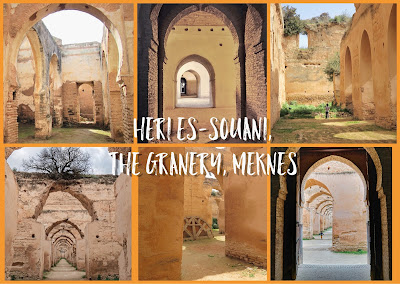


Heri es-Souani, (pictured above) was the king's (in earlier times, called "the sultan's,") immense granaries and stables... providing housing and food for 12,000 royal  horses. It was  built by Moulay Ismail, who was sultan from 1672-1727.  His legacy... the foundation of modern Morocco. He was the ruler responsible for putting Meknes on the map as one of Morocco's four imperial cities. The granary's massive vaulted walls and its tiny windows very effectively created cool storage conditions...now empty and roofless, but very impressive and atmospheric to view.  

Koubbat as-Sufara, once a reception hall for foreign ambassadors, has the same feeling as the granary with its similarly arched walls and mammoth network of rooms below ground. I loved that it's now being used to exhibit the work of local artists.


This network of rooms below ground was a mystery when discovered. Historians now believe that it was used for food storage, although our guide told us it was used as a dungeon for the Christian slaves who provided labor for Moulay Ismail's building projects. Haven't decided which story I want to go with...


I've left you with a lot to take in...this is Part One of our Moroccan Adventure. Part Two includes a stay in the desert, a visit to Moroccan Hollywood where very famous and familiar movies have been made, and a view of our final stop...the very happening and exciting city of Marrakech!  Please join me in a few days when I'll post Part Two.


Thanks for stopping by...see you soon?


Big Hugs,
abby